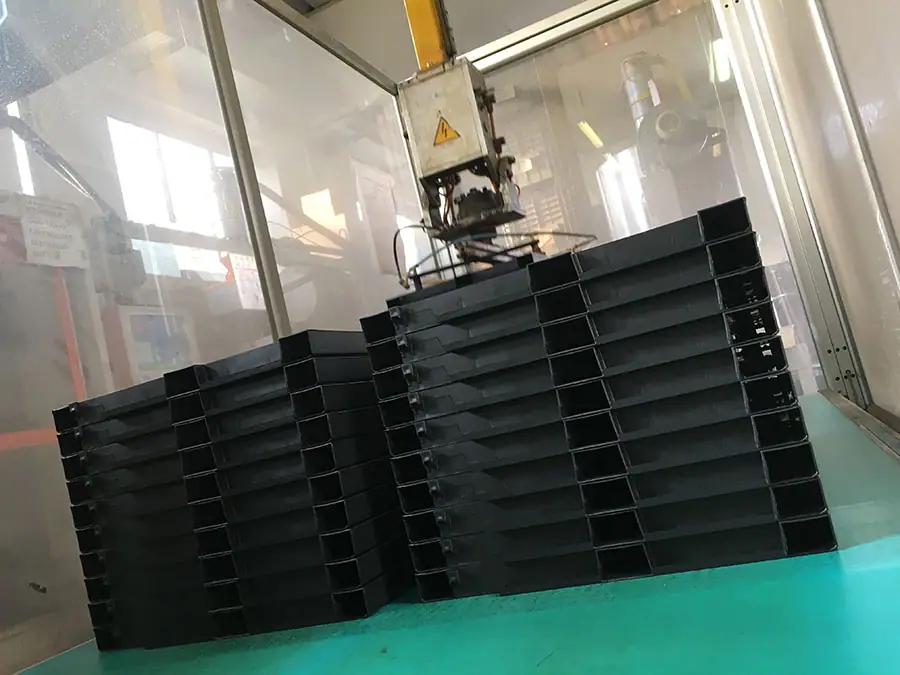



Injection molding is one of the most widely used manufacturing techniques in the plastics industry due to its efficiency, ability to produce large volumes, and capacity to create complex shapes. When brought to its melting temperature, any thermoplastic material (Polypropylene, Polycarbonate, Polyamide 6 – also known as Nylon, ABS) becomes a viscoelastic liquid without losing its inherent properties.
For processing, the material is melted in pellet form at temperatures above 200°C. Unlike rubbers or thermosetting polymers, which undergo irreversible structural changes when heated, thermoplastics can be melted repeatedly. Once melted, the material is injected into the mold cavities, where it cools and solidifies in the pre-engineered shape.